Hidden Technical Debt of AI Systems: Agent Runtime
Eleven years ago, Sculley et al. drew the diagram everyone in MLOps has seen: a tiny black box labeled “ML Code” surrounded by a sprawl of much larger boxes — data collection, feature extraction, configuration, monitoring, serving infrastructure. The point of the diagram was that the model code is the smallest piece of a real ML system, and that everything else is where the technical debt accumulates.
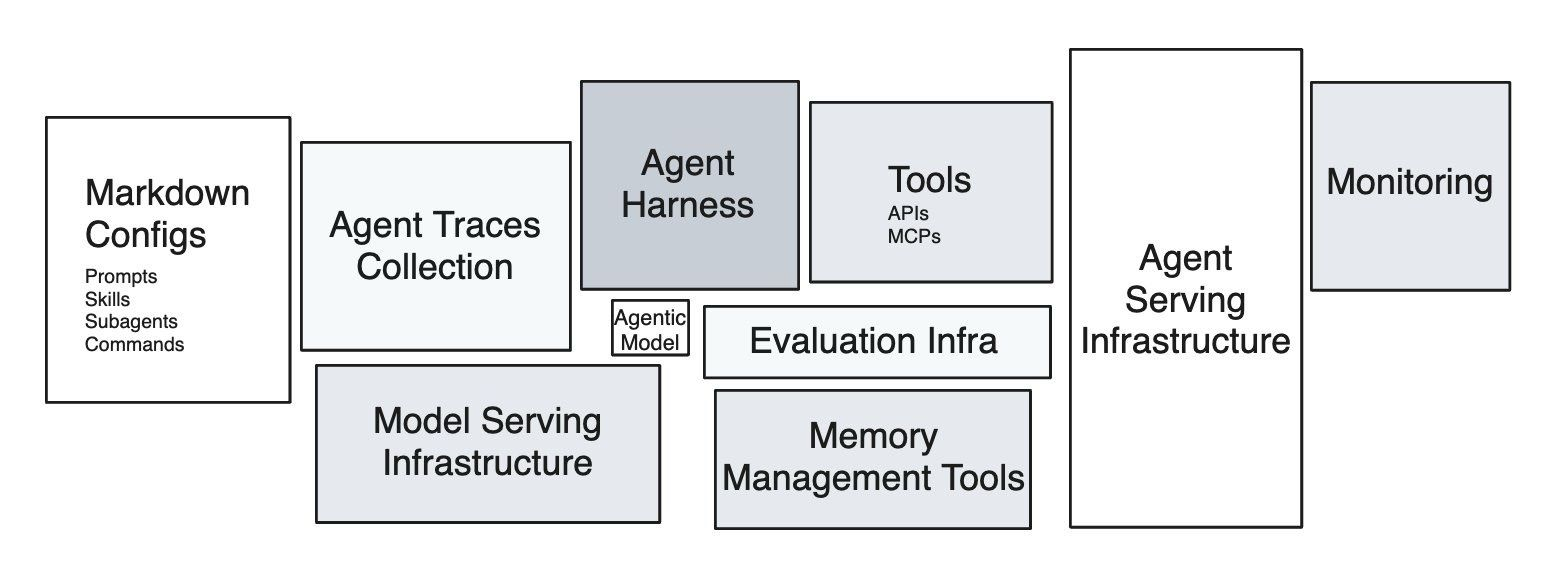
The same diagram is being redrawn for agents. The agentic model call is the small box. The largest box to the right that is currently driving most of the spend and influencing how system architecture will be done in the futureincidents, is the agent runtime, or agent serving infrastructure.
The agent is not the model. The agent is the harness plus the model, running inside the runtime. And almost nobody is treating it that way.
What an Agent Runtime Actually Is
A agentic model by itself maps from text input to text output. Other modalities are in play, but the primary fabric is still text. An agent is what you get when you wrap the agentic model with harnesses so it can take actions, observe effects, feed those observation back into the next call. The execution environment where that happens is the runtime.
Concretely, an agent runtime is the union of:
- compute substrate — a container, microVM, or full VM where code runs.
- filesystem the agent can read and write, often with snapshot and rollback semantics.
- tools — shell, code interpreter, browser, file editor, MCP servers — exposed to the model as callable interfaces.
- network boundary that defines what the agent can reach and what can reach it.
- state model that decides what persists across turns, across episodes, and across users.
- lifecycle controller that starts, suspends, snapshots, resumes, and tears down environments.
In the taxonomy of RL environments for LLM agents, these are the $H$ (harness) and $S$ (state) components. In production, this is the part that decides whether your agent finishes a task in eight seconds or eight minutes, whether two users can share an environment safely, and whether a malicious prompt can read your secrets.
Most teams shipping agents today have not built this layer. They have rented it, glued it together from cloud primitives that were designed for a different workload, or simply not thought about it yet. That last group is the one accumulating the most debt.
Why Sandboxing Is Not Optional
Models hallucinate code. They run rm -rf. They paste credentials into curl commands. They follow instructions embedded in untrusted documents. They retry the same failing command in a tight loop and burn through a quota. None of these are exotic edge cases — they are the modal behavior of capable models when handed unrestricted tool access.
The sandbox is what stops these behaviors from becoming incidents. Four reasons it has to exist as a first-class layer rather than a hopeful disclaimer in the system prompt:
Isolation against the model’s mistakes. A coding agent that mounts your repo and has shell access can, and eventually will, delete the wrong directory. Filesystem isolation, copy-on-write snapshots, and per-session ephemerality turn destructive actions into recoverable ones.
Isolation against prompt injection. The agent reads tool outputs. Tool outputs are attacker-controlled the moment the agent visits a webpage, opens a PDF, or processes a customer email. A sandbox is the only thing standing between an injected instruction and your production database. This is the agent-systems version of the SQL injection lesson, and we are at roughly the 2003 stage of learning it.
Multi-tenancy at training scale. RL training spins up thousands of concurrent rollouts. Each rollout needs its own filesystem, its own process tree, its own network namespace. Without strong isolation primitives, one rollout’s flaky shell command takes down a neighbor’s training step.
Reproducibility. A sandbox you can snapshot is a sandbox you can replay. Replay is how you debug a six-hour agent trajectory without re-running the whole thing. It is also how you turn a production failure into a regression test.
A web app’s runtime can be sloppy because the user is the one driving and a refresh fixes most things. An agent’s runtime cannot, because the agent will keep going long after a human would have stopped to ask a question.
The Cognition team is direct about this in their post-mortem on building Devin’s cloud agent infrastructure: containerized agents share a kernel, and a single compromised session can reach every other container’s filesystem, credentials, and network connections. Because agents generate their own code, run arbitrary commands, and probe the environment in unpredictable ways, kernel-escape is not a theoretical risk — it is the working assumption. Their conclusion, after more than a year of hypervisor engineering, is the same one the broader infrastructure community has converged on for any untrusted-code workload: VM-level isolation, where each session gets its own kernel and there is no shared attack surface.
Manus team has famously built and snapped shotted all their agent runtimes in a restorable format so users can come back in the future to replay what agents have done.
The Isolation Primitive Stack
Most of the differentiation between sandbox vendors lives one layer down, in the isolation primitive they pick. There are five primitives in serious use, with very different trade-offs.
| Primitive | Isolation model | Cold start | Workload fit | Notable users |
|---|---|---|---|---|
| Linux containers (runc, Podman) | Shared host kernel, namespaces + cgroups + seccomp | ~100ms | Trusted code, internal CI | Docker, Kubernetes default |
| Firecracker | KVM-based microVM, dedicated kernel per VM, ~5MB Rust VMM | ~125ms boot, sub-second from snapshot | Untrusted code at high density | AWS Lambda, Fargate, E2B, Fly.io |
| gVisor | Userspace kernel intercepting syscalls; runc-compatible runtime | Container-class | Defense in depth where a microVM is overkill; GPU virtualization | Google Cloud Run, App Engine, Modal |
| Kata Containers | Lightweight VM per pod, OCI-compatible | Few hundred ms | Multi-tenant Kubernetes | Confidential Containers, some managed K8s |
| V8 isolates | Per-tenant JS heap inside a single process | Sub-millisecond | JavaScript-only, no arbitrary binaries | Cloudflare Workers, Deno Deploy |
A few things are worth saying out loud about this table.
Containers are not a sandbox for agent code. They are a packaging and resource-control mechanism. The shared kernel means a kernel exploit, a misconfigured capability, or a sloppy seccomp profile takes down the isolation boundary. It is not okay for an agent that may execute attacker-controlled instructions hidden in a web page.
Firecracker is the de facto industry primitive for this category. AWS open-sourced it in 2018 to power Lambda and Fargate, and almost all agent-sandbox startup runs on top of it, including E2B, Fly.io, Vercel Sandbox. It boots a stripped-down Linux kernel inside KVM in roughly 125 milliseconds and uses about five megabytes of memory for the VMM itself. The combination of strong isolation, fast boot, high density is what makes thousands of concurrent rollouts economically viable.
gVisor is the middle path. It runs a userspace kernel that intercepts and re-implements Linux syscalls, giving you stronger isolation than namespaces without paying the full cost of a hardware VM. The trade-off is that some syscalls are slower or unsupported, which matters for workloads that hit the kernel hard. Google uses it for Cloud Run and App Engine; it is the right pick when you want defense-in-depth on top of containers but cannot move to microVMs.
Kata Containers fit a specific niche. They are an OCI-compatible runtime that wraps each pod in a lightweight VM, which lets you run untrusted workloads on Kubernetes without rewriting the orchestration layer. The cost is that you inherit Kubernetes’ assumptions about pod lifetime, which do not match how agents actually behave.
V8 isolates are the wrong primitive for general agent workloads. They are extraordinary for JavaScript-only edge compute but an agent that needs to run arbitrary Python, install packages, drive a browser, or execute compiled binaries cannot live inside a V8 heap. Cloudflare’s own Sandbox product addresses this by adding container-class compute alongside isolates.
The picks higher up the stack inherit these trade-offs. When a sandbox vendor advertises “VM-level isolation” they almost always mean Firecracker. When they advertise “millisecond cold starts” without VM isolation, they usually mean V8 isolates with a different threat model. The vendor brochure abstracts the primitive away; the threat model and the workload do not.
The Startup Sandbox Landscape
A category of “sandbox-as-a-service” companies has emerged in the last two years, almost all of them building on top of the primitives above. Northflank’s roundup of Modal Sandboxes alternatives is a good market snapshot — the differentiation is in the developer ergonomics, the snapshot model, and the mix of tools that come pre-wired, not in the isolation layer underneath.
| Vendor | Isolation | Snapshot model | Cold start | Notable design choice |
|---|---|---|---|---|
| Modal | gVisor | Filesystem diffs from base image | Sub-second from snapshot | GPU support |
| E2B | Firecracker microVM | Full VM snapshot | ~150ms | Open-source SDK, language-agnostic, popular in the agent dev community |
| Daytona | Containers / VMs | Forkable workspaces | Few seconds | Forked dev environments, OCI-compatible |
| Northflank | Containers, GPU-aware | Persistent volumes | Container-class | GPU sandboxes for agents that train or run inference inside the loop |
| Browserbase / Steel / Hyperbrowser | Containerized browsers | Session replay | Seconds | Browser-only runtimes for web agents — DOM, screenshots, CDP |
| Cloudflare Workers Sandbox | V8 isolates + containers | Object snapshots | Milliseconds | Edge-first, shared-nothing model |
| Vercel Sandbox | Firecracker | Snapshot from build | Sub-second | Tied to Vercel’s deploy and preview model |
The reference Modal case study is Ramp Inspect: a background coding agent that now writes more than half of Ramp’s merged pull requests, with each session running in its own Modal sandbox containing Postgres, Redis, Temporal, RabbitMQ, a VS Code server, and a VNC stack with Chromium. Filesystem snapshots are refreshed every thirty minutes by a cron, so a new session is working on a prompt within seconds. The lesson buried in that architecture is that the agent’s productivity is bounded by the runtime’s startup time, not by the model’s tokens-per-second.
The browser-runtime category exists because driving Chromium is its own engineering problem — CDP, profiles, residential IPs, captcha handling, session persistence — and no general-purpose sandbox has it built in. Expect this to consolidate into the general-purpose vendors over the next eighteen months, the same way headless browsers absorbed into the major test frameworks.
It is also worth noting what nobody on this list does themselves. None of these vendors writes their own hypervisor. They all stand on top of the primitives in the previous section, which is what lets the category exist. The startups that have tried to build a complete stack — including the hypervisor — have ended up looking more like Cognition: years of engineering investment to get something that is finally indistinguishable from “we run on Firecracker with custom snapshot logic.”
The Hyperscaler Sandbox Landscape
The hyperscalers got to this market late and are still catching up.
AWS Bedrock AgentCore ships a Code Interpreter and a Browser Tool as managed runtimes for agents. The isolation is microVM-class, the integrations point at the rest of the AWS data plane, and the pricing model is per-session. However, it has major gaps relative to the startups, where the runtime has to be coded and shipped like a Lambda function, instead of having the flexibility to support heterogeneous workloads, e.g, different agent harness + model combinations. Not a major problem for production, but a major problem for research and development.
Azure Container Apps Dynamic Sessions uses Hyper-V isolation and advertises sub-second start times for code interpreter sessions. It is the most directly comparable hyperscaler offering to E2B and Modal in terms of intent. The integration story is strongest if you are already on Azure OpenAI and AKS. It also suffers from the flexibility to support heterogeneous workloads.
GCP Cloud Run Sandboxes is ahead of the pack with the usability similar to Modal, E2B, Daytona and the likes. It’s built on top of Cloud Run, which uses gVisor. Supports heterogeneous workloads.
Lambda, Fargate, App Runner, Cloud Run. It is tempting to use these as agent sandboxes because they are cheap and already in your account. They are designed for stateless, request-response workloads with strict execution-time limits and no native snapshot model. They will work for a demo. They will not work for an agent that runs for six hours, mutates a filesystem, and needs to fork mid-trajectory.
The hyperscaler offerings are converging on the right shape — microVM isolation, fast snapshots, managed tools — but the primitives underneath were built for web workloads. The startups had the advantage of building on top of those primitives without inheriting the legacy product surface area.
Experimentation and Production Want Different Runtimes
One of the major difference how AI engineering differes from traditional web development is the difference in development and production infrastructure requiremetns. Here’s the difference between your training cluster (if you are training models), experimentation and evaluation runs, vs production workload.
| Dimension | Experimentation / Training | Production / Serving |
|---|---|---|
| Concurrency shape | Thousands of parallel rollouts, bursty | One session per user, steady-state |
| Cold start tolerance | Critical — 5s × 10k rollouts is real money | Forgivable — users wait |
| State model | Fork, branch, replay, snapshot | Durable, per-user, auditable |
| Network policy | Often offline or recorded for determinism | Open internet, real APIs |
| Failure model | Drop the rollout, sample more | Retry, degrade, page someone |
| Observability | Full trace, every token, replayable | SLOs, error budgets, sampling |
| Cost model | Spot, preemptible, batch | Reserved, predictable, latency-bound |
| Determinism | Required for reproducible runs | Often counterproductive |
| Lifetime | Seconds to minutes | Minutes to hours, or pinned for a session |
A training rollout wants to start in 200 milliseconds, run for thirty seconds against a frozen snapshot of the world, get scored, and disappear. A production session wants to start in two seconds, hold state for a forty-minute conversation, talk to the live internet, and survive a transient failure without losing the user’s work.
The production side has a requirement that almost nobody surfaces in eval reports: the agent needs to survive the async gaps in real engineering work. Cognition’s experience report is the cleanest articulation of this — an agent opens a PR, waits on CI, responds to a review comment, reruns tests, pushes a follow-up commit. Between each step there are minutes, hours, sometimes days where the agent’s working state has to persist. A containerized agent can only survive these gaps by burning compute to stay alive, and if the container is rescheduled or times out the session is lost. Their solution was hypervisor-level snapshotting of the full machine state — memory, process tree, filesystem — so compute shuts down while the agent is idle and resumes exactly where it left off when a CI result arrives. Building that took longer than any other piece of infrastructure they had shipped to date.
Optimizing the same runtime for both training and production is how you end up with a system that is too slow for training and too brittle for production. Most teams discover this after the first time they try to “just deploy what we trained on” and find the latency budget eaten by a startup model that was fine when amortized over ten thousand rollouts and intolerable when paid by a single user staring at a spinner.
Dev/Prod Parity Is the Real Problem
In 2011, Twelve-Factor App told us to keep development, staging, and production as similar as possible. That advice was about reducing the gap between where the engineer types code and where the code runs. For agents, the gap that matters is between where the agent trained and experimented and where the agent runs.
An agent learns the runtime. Tool latencies, failure modes, shell quirks, filesystem layout, the exact way ls formats output, the way the browser resolves redirects. The model picks up all of it during training and bakes it into the policy, or the optimizer (RLM or GEPA) picks up all of it during training and bakes it into the harness or the prompts. Move these to a different runtime and the behavior shifts. Tools that were idempotent become flaky. Commands that were instant now block. Snapshots that existed disappear. The agent has no abstract concept of “shell”; it has a concept of “the shell I trained on.”
This is a new flavor of distributional shift. It is not the data shift the MLOps community has been worrying about for a decade. It is runtime shift, and it shows up as silent quality regressions that no eval catches because the eval runs in the training runtime.
There are three honest paths through this:
Co-locate train and prod on the same runtime. Pick one sandbox provider, run RL rollouts on it, run production sessions on it, accept the lock-in. This is what the most disciplined AI engineering teams are doing.
Define a runtime contract and enforce it on both sides. A small, versioned interface — “this is the shell, these are the tools, these are the latencies, these are the failure modes” — that you implement once on your training infrastructure and once on your production infrastructure. The contract is the abstraction; the sandbox underneath can vary. This is harder than it sounds because the contract has to cover not just the API surface but the timing and failure semantics that the agent has learned.
Train against production noise. Inject latency, errors, and tool failures during training so the agent’s policy is robust to runtime variance instead of dependent on a specific runtime. Step-DeepResearch reports tangible gains from injecting 5–10% tool errors during training. This is the runtime analog of dropout.
The wrong answer, the one most teams are unconsciously picking, is to pick a sandbox for production as a software engineering solution, and forget all about the requirements from AI and machine learning, then spend the next quarters chasing flakiness of agent performances.
The Bill That Is Coming Due
Sculley’s argument was that ML systems accumulate technical debt in places that traditional software engineering does not have language for — feedback loops, configuration sprawl, undeclared consumers, glue code. Agent systems inherit all of that and add a new line item: the runtime debt.
Runtime debt looks like this. A team picks the sandbox that was easiest to integrate at prototype time. Production traffic exposes a different mix of failure modes. The team patches around the gap with retries, longer timeouts, and prompt-engineered apologies. The agent’s behavior gets entangled with that runtime’s quirks with whack-a-mole without disciplined research and development. A year later, switching runtimes is a six-month migration because nobody can predict which behaviors will move.
The agent has to live on a runtime. The teams that internalize that early will spend the next two years compounding the advantage. The teams that do not will spend the next two years paying down a debt they did not know they were taking on.
References
- Sculley, D., Holt, G., Golovin, D., Davydov, E., Phillips, T., Ebner, D., Chaudhary, V., Young, M., Crespo, J.-F., & Dennison, D. (2015). Hidden Technical Debt in Machine Learning Systems. NeurIPS. https://papers.nips.cc/paper_files/paper/2015/hash/86df7dcfd896fcaf2674f757a2463eba-Abstract.html
- Wiggins, A. (2011). The Twelve-Factor App. https://12factor.net/
- Lee, H. (2026). A Taxonomy of RL Environments for LLM Agents. Han, Not Solo. https://leehanchung.github.io/blogs/2026/03/21/rl-environments-for-llm-agents/
- Workman, G. (2026). How Ramp built a full-context background coding agent on Modal. Modal Blog. https://modal.com/blog/how-ramp-built-a-full-context-background-coding-agent-on-modal
- Lopopolo, R. (2026). Harness engineering: leveraging Codex in an agent-first world. OpenAI. https://openai.com/index/harness-engineering/
- AWS. (2025). Amazon Bedrock AgentCore. https://aws.amazon.com/bedrock/agentcore/
- Microsoft. (2024). Azure Container Apps Dynamic Sessions. https://learn.microsoft.com/en-us/azure/container-apps/sessions
- E2B. Open-source runtime for AI agents. https://e2b.dev/
- Modal. Sandboxes documentation. https://modal.com/docs/guide/sandbox
- Modal. (2025). Serverless HTTP. https://modal.com/blog/serverless-http
- Hu, et al. (2025). Step-DeepResearch. arXiv. https://arxiv.org/abs/2512.20491
- Firecracker. AWS open-source microVM. https://firecracker-microvm.github.io/
- Cognition. (2026). What We Learned Building Cloud Agents. https://cognition.ai/blog/what-we-learned-building-cloud-agents
- Northflank. (2026). Top Modal Sandboxes Alternatives for Secure AI Code Execution. https://northflank.com/blog/top-modal-sandboxes-alternatives-for-secure-ai-code-execution
- Google. gVisor — application kernel for containers. https://gvisor.dev/
- Kata Containers. Lightweight VMs that feel like containers. https://katacontainers.io/
- Cloudflare. How Workers works — V8 isolates. https://developers.cloudflare.com/workers/reference/how-workers-works/
@article{
    leehanchung,
    author = {Lee, Hanchung},
    title = {Hidden Technical Debt of AI Systems: Agent Runtime},
    year = {2026},
    month = {04},
    day = {24},
    howpublished = {\url{https://leehanchung.github.io}},
    url = {https://leehanchung.github.io/blogs/2026/04/24/hidden-technical-debt-agent-runtime/}
}